Think of gesture drawings not only as a warm up to get you going, but to also help you plan out a drawing or composition. This is especially useful for figure drawings and for drawings where you need to capture the essence of your subject.
Though gestures capture the essence of your subject, they don't necessarily have to be able to be viewed as a coherent piece--it's ok for them to be indiscernible scribbles, just as long as it captures the motion of your drawing.
You can also combine gesture drawing with outline drawing to get more detail, while still maintaining a loose drawing style. Below are preliminary sketches by Honore Daumier for his painting The Carnival Parade. See how using gesture drawings can help capture the movement and expression of your subject?
Study for the Parade by Honore Daumier
Study for Parade 2 by Honore Daumier
The Carnival Parade by Honore Daumier
Below is another example from Daumier showing a more tightly controlled, but still loose gesture drawing.
Crosshatching and Hatching are both useful techniques to create a wide range of values.
Hatching marks are parallel to one another. You can create the illusion of value with hatching by placing the lines closer together or making them vary in thickness. Crosshatching marks are hatching marks that intersect and can be used to give objects form and depth.
Changing mediums can give a completely different feel when using crosshatch and hatch techniques.
Think of a outline drawing as the scaffolding of a piece. The things to hold it together to help you reach your goals. An outline drawing at it's most basic does away with the complexity of a value scale, while maintaining the complexity of hand-eye coordination.
It can sometimes help to imagine outline drawings as coloring book pages. Let's start simple:
There
is no indication of value here; it is as flat as the paper it's drawn
on. That's essentially what a outline drawing is. It should look like a
two dimensional object. Let's get a bit more complex:
Still
a relatively simple piece, but with a few changes. The subjects are more detailed and have a wider range of line widths and overlapping
figures--all things that give it a more 3 dimensional appearance. Though
more complex and detailed than the above flowers, this is still
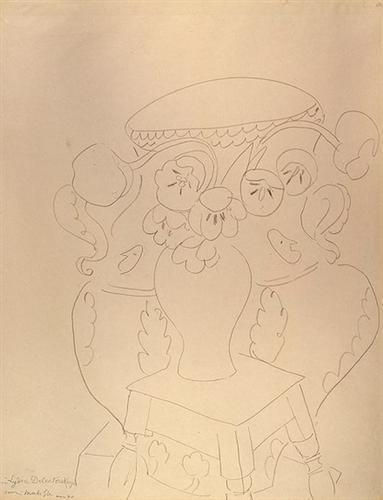
essentially a outline drawing. Let's move on to more relevant examples with a still life by Henry Matisse:
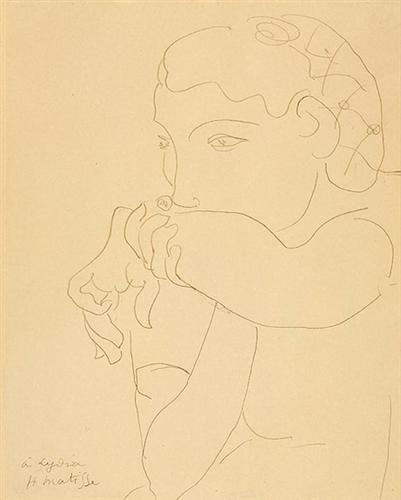
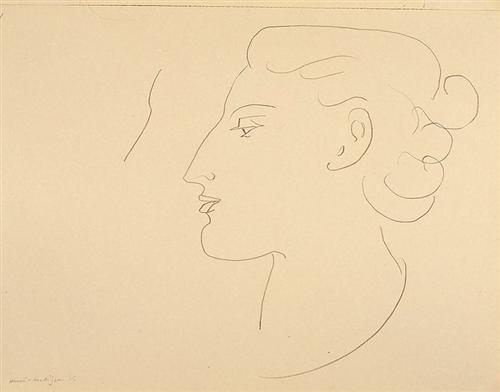
A few other more simple Matisse outline drawings:
Notice the similarities between all four pieces: the lack of shading
and fine details. All the subjects have been simplified to their most basic outline.
An
outline shouldn't be perfect and you shouldn't feel the need to erase
your 'mistakes'. Just draw what you see in front of you. It's all about
training your hand eye coordination.
Contour Drawing is about learning to see. It’s a slow inspection of the subject, a careful examination of it’s parts, in a continuous line drawing. Try not to lift your pen/pencil off of the paper and look at your subject as much as you can. This helps you train your hand eye coordination and also helps to translate things from a 3D space to a 2D space.
Blind contour is similar to regular contour drawings, except instead of occasional glances at your paper, the goal is to not look at your drawing at all. Only focus on the subject. For many beginners their blind contours will more resemble scribbles, but with time and practice, you will find your drawings having a bit more form.
Here are some examples of contour drawings and blind contour drawings of the same subject to show the difference: